 03 9489 4766
  2
2 Public sculpture in Melbourne – Dervish by Clement Meadmore
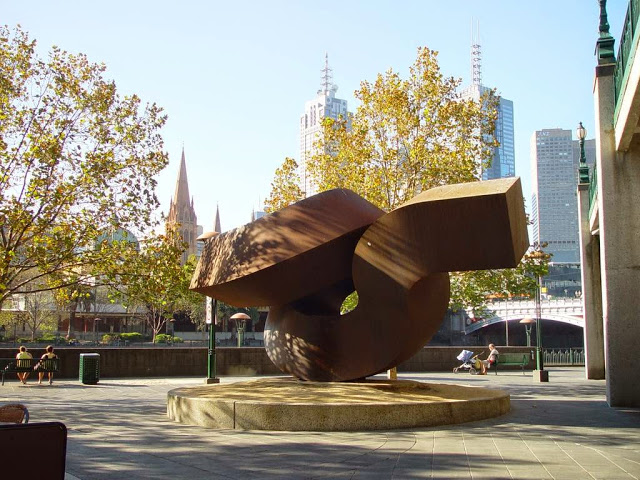
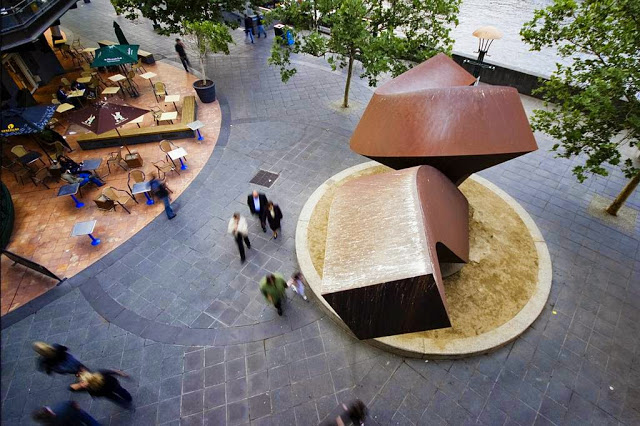
First installed on the upper level at the entrance of Hamer Hall, and later relocated in the early 1990s to its current position along the Southbank riverside promenade, the five-tonne sculpture “Dervish” commands attention.
Bold yet restrained, “Dervish” is an imposing work of minimalist public sculpture. Its mass and scale are undeniable, yet the form appears remarkably fluid.
Effortless Form in Solid Steel
Like many of Meadmore’s sculptures, “Dervish” possesses an almost effortless sense of movement despite its size and material weight. The work appears as though it has been formed from a single, continuous length of steel, twisted and looped back onto itself in one elegant gesture.
It is this interplay between fluid appearance and rigid material that captures the viewer’s imagination. The sculpture invites the question: How was it made? Its geometric precision combined with apparent simplicity makes it visually compelling and widely appealing.
Interestingly, beyond its sculptural significance, “Dervish” has also became an informal playground for children, a testament to the accessibility and physical presence of well designed public art.
The Mind Behind the Form
Clement Meadmore was both an industrial designer and a sculptor, and he briefly studied aeronautical engineering. His interest in mathematics and structural logic is evident in his work, particularly in his exploration of geometric manipulation and spatial balance.
A related example of his sculptural language, “Awakening,” can be found at St James Square on Bourke Street, another striking example of minimalist steel sculpture integrated into Melbourne’s urban environment.
Images courtesy of https://geolocation.ws/

 03 9489 4766
 info@lump.com.au